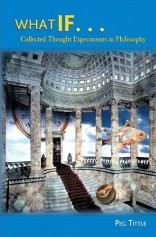
 What If?... Collected Thought Experiments in Philosophy (Longman, 2005) - Peg Tittle
You want a mental challenge? Put down your Sudoku and pick up What If… I’ve decided henonine should be permitted, but not required. Mr. Oreo’s still black – okay, black-skinned. And Smith and Jones are equally guilty. I think. But are the randomly generated objects art? Dunno. And I’m still trying to figure out how I could figure out what “gavagai” means.
-Annonymous
Peg Tittle's What If . . . is the most valuable instructional tool I have ever used in my philosophy classes. By ferreting out familiar thought experiments that many of us have repeated so often that we can no longer remember their origins, she did the dirty work that the rest of us were too lazy to tackle. Her commentaries are just enough to highlight the depth and acuity of these illustrations, all in language accessible to undergraduates. If Tittle's aim was to demonstrate the richness of philosophy through well-chosen, succinct puzzles that the reader would not soon forget, she accomplished that aim splendidly. This book belongs in every introduction to philosophy class.
But make no mistake: What If . . . is not just a text for the classroom. Anyone interested in philosophy needs this book. If you want a concise illustration of the mind-body problem, Tittle gives you several that do the job. If you never understood the free will v. determinism debate, the perfect examples are here to get you wondering. And if you need reminders about why Plato, Descartes, Hume, and the other great dead were so great, they’re here alongside plenty of contemporary thinkers, all showing us how to pursue the examined life. Tittle’s ability to distill the best from 2,500 years of philosophy is unsurpassed.
- Ron Cooper, Ph.D., is the author of the satirical novel Hume’s Fork and many philosophical works. www.roncooper.org
The somewhat deceptive title aside (the thought experiments are much more substantive than silly "what if..." scenarios), this collection of (mostly) bite-sized bits of philosophy, nicely organized into categories like metaphysics, knowledge, or ethics, has its place on my shelf. It's not only a good reference for finding famous thought experiments or puzzlements, it's also a nice way to get a taste of a variety of periods and ideas.
- J. Robbins
- Dale Jamieson, Professor of Environmental Studies and Philosophy, NYU
This is a really neat little book. It would be great to use in *discussion*-based philosophy courses, since the readings would be nice and short and too the point. This would probably work much better than the standard anthology of readings that are, for most students, incomprehensible.
-Nathan Nobis, Morehouse College
|