|
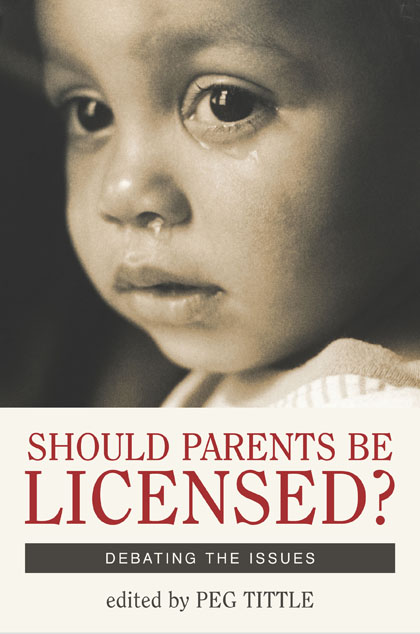
Should Parents Be Licensed?: Debating the Issues (Prometheus, 2004) - Peg Tittle
Reading about
parents who entomb their babies in cement or who abandon their
children as a matter of course makes me think that Peg Tittle is on
to something.
The Ontario, Canada writer and
former philosophy professor is the editor of a collection of essays
called Should Parents
Be Licensed? Debating the Issues.
The name is provocative
enough. But listen to the titles of some of the pieces included in
the book: “Can Having Children Be Immoral?” “Is There a Natural
Right to Have Children?” “The Mythology of Family Planners.”
Granted, these are some of the
more incendiary ideas included in the book, published last summer by
Prometheus Books.
When you hear about the
abominable things parents are capable of doing to their children,
though, drastic measures seem less objectionable.
An Ontario County Court judge
this week wrapped up the criminal case against the father who helped
hide his wife’s murder of their newborn by concealing the body in a
tub of concrete. Brian DeBeer was sentences to 1/3 to 7 years in
prison for hindering prosecution.
His wife is already serving 30
years to life for killing the newborn and another infant, whom she
said she disposed of without her husband’s knowledge.
But the story may not end
there. The father’s attorney has said the daddy wants custody of
the couple’s three other children, including one born while the
mother was in prison.
In another case of parenting
gone wrong, the troubled mother whom a Monroe county judge famously
ordered not to reproduce was in court again this week.
Sort of, anyway. Stephanie
Pendleton didn’t appear for a hearing on Monday where Family Court
Judge Marilyn O’Connor terminated her parental rights to a toddler
son. Three other children, all born with cocaine in their systems,
are with relatives.
These are the kinds of
egregious child abuse cases that advocates say could be avoided
through parental licensing, a concept from the early 1970s that
periodically makes its way back.
The debate on how to regulate
human cloning is what got Tittle thinking that maybe rules should be
applied to all parents.
She saw an inconsistency in
making regulations for cloning humans and, say, putting potential
adoptive parents through a rigorous screening process while giving
biological parents a pass.
“Why should we set the bar
higher if we’re going to create life this way rather than another
way?” she tells me by phone.
Tittle supports a mild form of
licensing; maybe potential parents would have to prove maturity
(i.e., age) and knowledge (i.e., a parenting course).
There’s not much support for
these or other ideas in the book supporting parental licensing.
Denise-Marie Santiago, Rochester
Democrat &Chronicle
Procreation is
a natural part of being human; indeed, it’s a natural part of life
in general. It may not be one of those things that “simply happens,”
but it does happen without always a great deal of forethought and
preparation. There are some who argue, though, that it should – not
simply preparation in the sense of planning on the part of the
couple, but also on the part of the state. There are some who argue
that parents should be licensed.
Summary
Title: Should
Parents Be Licensed? Debating the Issues
Pro:
Con:
Description:
Book Review
Because parenthood is regarded
as one of the most natural things in the world, most people will
react very negatively to any suggestion that a license should be
required before being allowed to procreate. That would be like
forcing people to have a license in order to breathe or walk – being
a parent is a right rather than a privilege such as driving. But
should it be? We must keep in mind that there is a lot at stake for the children themselves. When a two people become parents, there is suddenly at least one more individual whose interests must be taken into consideration: the child. Shouldn’t children only be born into homes where they are wanted? Shouldn’t children only be born into homes where the parents know what they are doing, know how to raise kids, and can provide the children with a psychologically and emotionally healthy atmosphere? Of course – no one can deny that this would be ideal. The question is, should the state do anything to legally enforce it?
This is the central theme in
Peg Tittle’s book Should
Parents Be Licensed? Debating the Issues. This is not a subject
that is debated very much, which would explain why this is one of
the only books available right now that addresses it. It’s a very
emotional issue because, as I noted above, so many people treat
procreation as a right that shouldn’t be closely regulated by the
government. Even a suggestion that there be licensing and regulation
can be met with aggressive attacks.
Although such a reaction may
be understandable, there are fair reasons for at least raising the
matter. As I also noted above, we can’t ignore the fact that once
people become parents, there are automatically other interests
involved. The government doesn’t have any outside rights to protect
that would justify regulating people’s sexual activity, but there
are outside rights to protect that could affect whether people go so
far as to have children.
We have to face the fact that
there are people out there who are parents and who probably
shouldn’t be. They may lack the intellectual, the emotional, or the
psychological resources to raise children properly. Being a parent
isn’t easy – it’s not for everyone, even though there are social
pressures in society for everyone to have kids. Thus, the question
isn’t so much whether some people should refrain from having kids or
even should be encouraged to refrain from having kids. Instead, the
question is whether the state should step in enforce such an ideal.
The first hurdle to a
licensing scheme would be coming up with a means that would prevent
people from having unapproved children, a hurdle which may not be as
tough as it first appears. In one article, Roger McIntire describes
a fictional scenario in which a drug can permanently prevent
conception until an antidote is created. Such a product would be
incredibly popular, but it would raise the question of control. The
state could, for example, restrict access to the antidote. It
wouldn’t take many steps to force everyone to take the contraceptive
and keep the antidote out of the hands of any but those who passed a
test.
Here, though, we come up
against the larger hurdles that would inhibit the creation of a
licensing system: what sorts of skills get tested, what sorts of
standards will be enforced, and what sorts of tests will exist? This
sounds at first like insurmountable hurdles until you remember that
they already exist and are already enforced. People already accept
the role of the state in deciding who does and does not deserve to
be a parent when it comes to custody cases, foster care, and
adoption. Roger McIntyre writes:
“Can you imagine the
public outcry that would occur if adoption agencies offered
their children on a first-come-first-served basis, with no
screening process for applicants? Imagine some drunk stumbling
up and saying, “I’ll take that cute little blond-haired girl
over there.””
We could also describe a
similar scenario in the context of cloning human beings. Someday
this will be possible, but do you really think that it will happen
without state regulation? On the contrary, there will be all kinds
of regulations. Those doing the cloning will have to ensure that
they don’t create human beings who are sick or will be suffering
from chronic pain. Cloners will have to provide good reasons for
what they are doing — they won’t be allowed to create their own
armies, for example, or clone for the sake of personal
gratification.
In other words, we don’t
permit irresponsible adoption and we wouldn’t permit the
irresponsible creation of human life via cloning. Nevertheless, we
do permit irresponsible parenthood and creation of life through
natural means. Isn’t there a bit of a contradiction there? If people
don’t have a right to adopt and don’t have a right to create life
via cloning, why do we think that they have a right to create life
via sexual reproduction? What is it about the creation of life that
would qualify as a “right” in the first place? Surely it can’t be a
“right” merely because it is a natural activity.
Even if it is a right, though,
no right is absolute. Is there a right to have children who would
suffer from serious, painful, and debilitating diseases? Is there a
right to have children that is completely decoupled from your
responsibility to properly and adequately raise it? These are all
very good and interesting questions — questions that are addressed,
even if not completely answered, by authors represented in the book.
The subject of licensing
parents is more likely to attract outrage and derision than serious
reflection or debate. This is understandable, but it’s also
unfortunate. People have been procreating for millennia without
government interference, so why should we start now? The age of a
practice is not, however, an argument on behalf of its validity.
Perhaps we can do better than our ancestors. Perhaps the arguments
in favor of some licensing scheme are better than those against —
but you’ll have to seriously listen to and reflect upon them first
before you can reach that conclusion.
Austin Cline, atheism.about.com
You need a
licence to drive a car, own a gun or fish for trout. You don't need
a licence to raise a child.
But maybe you should.
At least that's the opinion of
Peg Tittle, a writer/philosopher who has edited a new book of essays
called Should Parents
be Licensed?
"I don't think the creation of
life should be chaotic, unplanned, accidental or passionate," says
Tittle.
"Sex can be all that – but not
creating a life."
A local parenting expert,
however, is aghast at the idea.
"You can't mess with this,"
says Karen Goldthorp, who helps parents hone child-raising skills
with her Stratford-based company, Keys in Developing Solutions
(KIDS). "This is the way it's supposed to be."
Tittle's new book (published
by Prometheus Books) contains about two dozen essays by various
experts, including psychologists, lawyers and sociologists.
And though their topics range
from genetic engineering to prenatal abuse, Tittle says they all
agree on one thing: That though we devote much time and talk to the
idea of ending a life (including abortion, capital punishment and
euthanasia), we are far too laissez-faire about starting it.
"There should be some notion
of responsibility, intentionality and deliberateness," she says.
Anyone who attended this
week's domestic violence conference at the London Convention Centre
(or anyone who follows the news) would know one painful fact: There
are a lot of broken people out there.
And a lot of that damage –
damage that is, in many cases, largely irreversible – occurs during
the first few years of a child's life.
Indeed, a new study at the
University of Western Ontario pegs the financial costs of child
abuse in Canada at more than $15 billion, including more than $1.1
billion in social services, $600 million in judicial costs, $222
million in health costs and almost $24 million in special education
services.
To be honest, it takes nothing
more than a trip to the local mall to confirm there are a lot of
lousy parents. (Not you, of course. And definitely not me.)
So what do we do?
Tittle suggests potential
parents should meet some minimal requirements: They must be 18 or
older, they must not be addicted to drugs or hooked on booze and
they must complete a course in child development.
Tittle also agrees with one of
the essayists in her book, who suggests that adolescents should be
required to submit to a contraceptive vaccine (a concept Tittle says
is more dependable than current contraceptives and which, she
suggests, would be technically feasible if only enough money were
poured into research).
"That changes the default mode
– you have to do something intentional to have kids," she says. "At
the very least, you have to go to the drugstore to get the
antidote."
But Tittle bristles at the
suggestion some alcoholics and heroin addicts have straightened out
when faced with the prospect of parenthood. "You don't create a little human being to be your personal rehab program," she says, adding she's leery of most of the motives people profess for having kids. "This idea of using someone else for your joy, or for proof of your maturity, or for your satisfaction or fulfilment – there's something morally suspect about that. That's using a human being."
Tittle says she isn't sure how
society would treat unlicensed parents. "That's an implementation
problem. We could be draconian and say any unlicensed kids are taken
away from their parents, but that's the extreme."
She says she's wary that
licensing parents could lead to licensing only certain kinds of
parents – such as only those who are white, rich, Christian, etc.
And she insists most parents would meet – and indeed welcome – such
requirements.
"We don't have to license only
the best parents," says Tittle, who is childless by choice. "We just
have to not license the worst."
But in Stratford,
child-rearing expert Goldthorp argues parenting is a lot like life –
chaotic, imperfect and filled with flaws.
"I think there are no mistakes
– I think that's how we learn," says Goldthorp. "Don't you believe
we all came here with our own gift to offer? You have to be allowed
to stumble and fall."
Ian Gillespie, London
Free Press
|