|
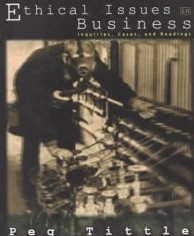
Ethical Issues in Business: Inquiries, Cases, and Readings (Broadview, 2000) - Peg Tittle
The core of
this text comprises chapters on all the key issues of business in
Canada today. Each chapter includes a hypothetical case study and
an introduction by the editor highlighting key ethical points; two
academic essays; and a real-life case study. Questions for
discussion accompany the essays and case studies. The editor has
also included a general introduction to ethical theory; a section on
institutionalizing ethics (discussing ethics
officers/programs/codes, etc.); and appendices providing excerpts
from important classic contributions to ethical theory and relevant
Canadian law. The result is a comprehensive and useable course text
particularly helpful for Canadian students.
Society for Business Ethics
Newsletter
Ethical Issues in Business is
a comprehensive package of articles, cases, and background
discussion that provides an outstanding introduction to the subject
for Canadian students. The text breathes fresh air into the study
of business ethics; Tittle’s breezy, use-friendly style puts the lie
to the impression that a business ethics text has to be boring.
Paul Viminitz, University of
Lethbridge
Any
non-Canadians willing to overlook the exclusively Canadian origin of
the case studies will find that the issues raised apply
universally. More to the point, they will find themselves in
possession of a superb introduction to ethics in business. Steve Deery, The Philosophers’ Magazine
Peg
Tittle wants to make business students think about ethics. So she
has published an extraordinarily useful book that teaches people to
question and analyze key concepts.
Take profit, for example.
Nothing in the pantheon of business topics is more central than
profit.
“Most business students seem
to assume that profit is good,” says Tittle, who teaches at
Nipissing University’s Centre for Continuing Business Education.
Many assume the pursuit of
profit is the reason for being in business. Some even assume it’s a
right. But Tittle challenges Canada’s future business leaders to
justify profit on ethical grounds.
Suppose you’re an upper-level
manager of a company and you have a midlife crisis. You consider
suggesting a profit ceiling to the board of directors.
Maybe by relaxing the bottom
line, you can pay a fairer price to your suppliers or buy costlier
but more environmentally responsible materials; maybe you can lower
prices; maybe you can increase wages and benefits; maybe you can
afford fringe programs now on the back burner.
Then, you begin to consider
the possible downside of a profit ceiling.
Will investors buy your shares
and brokers recommend the stock if your company has voluntarily
limited its profit? Why settle for a 6 per cent rate of return when
you can a get 7 or 8 per cent elsewhere?
As a senior executive of the
company, you will be giving up the bonus you receive when profits
are higher, money that helps fund extras that improve your family’s
quality of life.
So, you reconsider. Maybe
instead of limiting profits, you can use the profit the company
makes to enhance its reputation and stability, and thus increase the
level of job security for all employees.
The company can give part of
after-tax profit to charities, worthy environmental projects or
community recreation programs, or start a profit-sharing program
with workers.
Does profit-sharing make high
profits ore morally acceptable? Or is it a way of co-opting workers
into accepting the typical corporate mentality of profit before all
else?
Why don’t all private
companies have a profit-sharing plan for their employees? Can you
think of reasons why employees might not be interested in such a
plan?
These are among the questions
Tittle raises when talking about profit. She also throws in a
couple of academic essays from theJournal of Business Ethics and
a case study of a Quebec pulp and paper mill that went from losses
to profits after an employee buyout in 1972.
Profit is one of a dozen
issues she holds under the microscope in her book, Ethical
Issues in Business: Inquiries, Cases, and Readings (Broadview
Press, $36.95).
She also analyzes
whistleblowing, advertising, product safety, employee rights,
discrimination, management and union matters, business and the
environment, the medical business, and ethical investing.
Released in the spring of
2000, the book is crammed with Canadian content and current case
studies. The only thing missing is a look at the controversy
surrounding the Sudanese operations of Talisman Energy Inc. of
Calgary.
Still, Tittle manages to
include the Westray mine disaster in Nova Scotia; the unionization
of a McDonald’s restaurant in Squamish, B.C.; the fuel-cell
technology developed by Ballard Power Systems Inc.; and the
drug-testing battle between Dr. Nancy Olivieri and the Hospital for
Sick Children in Toronto.
This text breathes fresh air
into the study of business ethics. The book begins by introducing
students to ethical theory – from Aristotle’s list of virtues to Ayn
Rand’s definition of altruism – and saying that an ethics course is
like a math course: “How you get the answer is, in many respects,
more important than the answer itself.” Ellen Roseman, The Toronto Star
|